What is inside NervoLyn
Skip to the Point
One NervoLyn capsule contains 80 mg of elemental magnesium (19% DV) from magnesium glycinate, plus a 575 mg proprietary blend holding magnesium glycinate, alpha lipoic acid, butcher's broom root extract, L-carnitine, turmeric rhizome extract at 95% curcuminoids, and coenzyme Q10. The blend total is printed; the split inside it is not. Everything else in the capsule is a standard carrier or the vegetable shell itself.
The label, exactly as printed
This is the Supplement Facts panel from the bottle you will receive. We publish it here before you buy rather than after, because a label you can only read once the box arrives is not much use for making a decision.
Supplement Facts
Serving Size: 1 Capsule
Servings Per Container: 30
| Amount Per Serving | % Daily Value | |
|---|---|---|
| Magnesium (as Magnesium Glycinate from proprietary blend) | 80 mg | 19% |
| Proprietary Blend | 575 mg | † |
| Magnesium Glycinate, Alpha Lipoic Acid, Butcher's Broom (Ruscus aculeatus) Root Extract, L-Carnitine, Turmeric (Curcuma longa) Rhizome Extract 95% Curcuminoids, Coenzyme Q10 (as Ubiquinone) | ||
Percent Daily Values are based on a 2,000 calorie diet. † Daily Value not established.
Other Ingredients: Hypromellose (Vegetable Capsule), Microcrystalline Cellulose, Magnesium Stearate, Stearic Acid, Silicon Dioxide.
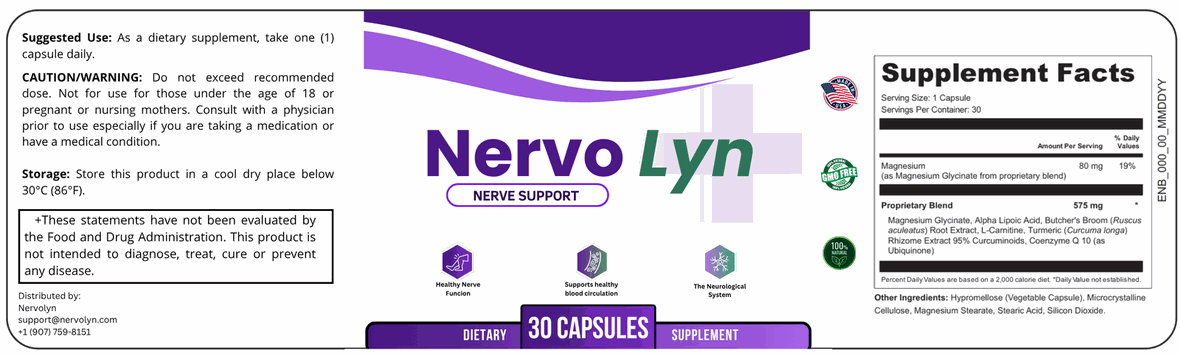
About the proprietary blend. Six of the seven actives are grouped into a single 575 mg figure, so the milligram amount of, say, the alpha lipoic acid on its own is not published. We are not going to guess at it and print a number that is not on the bottle. If exact per-ingredient dosing is a requirement for you, that is a fair reason to choose something else, and we would rather you know now than after the box arrives.
What we can tell you is that the blend is listed in descending order of weight, which is how U.S. labelling works: magnesium glycinate is the largest component, coenzyme Q10 the smallest.
Suggested use. As a dietary supplement, take one (1) capsule daily.
Warning. Do not exceed the recommended dose. Not for use by anyone under the age of 18 or by pregnant or nursing mothers. Consult a physician prior to use, especially if you take medication or have a medical condition.
Storage. Keep in a cool, dry place below 30°C (86°F).
The three jobs the formula is trying to do
One: keep the mineral side of nerve signalling topped up
Magnesium is the only ingredient in NervoLyn with a stated amount, and there is a reason it leads. The mineral is a cofactor in several hundred enzyme reactions, including the ones that regulate nerve impulse conduction and muscle contraction, and national survey data has repeatedly shown that a large share of American adults take in less than the recommended amount from food[1]. At 80 mg per capsule you are getting 19% of the daily value, which is a top-up rather than a full replacement, and that is deliberate: this is a supplement meant to sit alongside a reasonable diet.
The form matters as much as the number. Magnesium oxide is cheap and delivers a lot of magnesium on paper, but a good deal of it passes through. Magnesium glycinate is the mineral bound to the amino acid glycine, and it is the form most people find gentlest, which is what you want in something taken every morning for months. Glycine itself is a quiet inhibitory neurotransmitter, which is a pleasant coincidence in a nerve formula rather than a claim we are making.
Two: support oxidative balance in nerve tissue
Nerve fibres in the hands and feet are the longest cells in the body, and length makes them vulnerable: everything has to travel further, and the metabolic housekeeping has to work harder. Alpha lipoic acid is in the blend because it is unusual among antioxidants in being both water and fat soluble, so it can operate in parts of a cell most others cannot reach, and it is regenerated rather than consumed after it does its work[2]. It has been studied in the nerve context for decades, more than any other ingredient in this bottle.
Turmeric comes in as a rhizome extract standardised to 95% curcuminoids rather than as culinary turmeric powder, which typically runs around 3% curcuminoids. That distinction is the whole point: the research on turmeric is research on curcuminoids, and a formula that used the kitchen spice would need many times the weight to be comparable[3]. Curcuminoids are also poorly absorbed on their own, which is one practical reason we suggest taking the capsule with food that contains some fat.
Three: keep blood and energy reaching the far end of the network
A nerve is only as comfortable as its blood supply. The vessels that feed peripheral nerves are extremely small, and when flow through them is sluggish the nerves at the end of the line notice first[7]. Butcher's broom root extract is the traditional circulatory botanical in the blend, used in European herbal practice for centuries in formulas aimed at heavy, tired legs.
L-carnitine and coenzyme Q10 handle the energy half of that story from two different positions. Carnitine's job in the body is transport: it carries long-chain fatty acids across the mitochondrial membrane so they can be burned for fuel[4]. Coenzyme Q10 is already inside that membrane, working as part of the electron transport chain and as a fat-soluble antioxidant in its own right[6]. Tissues with heavy energy demands, nerve tissue among them, carry the most of it.
What we are not claiming
NervoLyn is a dietary supplement. It is not approved by the Food and Drug Administration, because dietary supplements are not approved by the FDA at all; the agency regulates them as a category of food, and manufacturers are responsible for the safety and labelling of what they sell[8]. What that means in practice is that NervoLyn is made in an FDA-registered facility that follows current Good Manufacturing Practice rules, and that no government agency has reviewed or endorsed any benefit statement on this page.
So, plainly: NervoLyn does not treat, cure or prevent neuropathy, diabetes, nerve damage or anything else. It supports normal nerve function, circulation and cellular energy in healthy adults. If your symptoms are new, worsening, one-sided, or accompanied by weakness, that is a conversation for a doctor and not a supplement[5]. Peripheral symptoms have a long list of causes, several of which are worth catching early.
Our quality standards, in short. NervoLyn is blended, encapsulated and bottled in the United States in an FDA-registered facility operating to cGMP standards. Every production run is tested by an independent laboratory for identity and potency before it is released for sale, and the finished bottles are held to the same specification each time. We do not publish batch numbers or certificates on this website, because we would rather point you to the label and the guarantee, both of which you can actually check.
A short glossary
- Peripheral nerves
- The nerves outside the brain and spinal cord, including the long ones running to the hands and feet. These are the fibres that carry sensation and are usually where tingling or numbness is first noticed.
- Chelate
- A mineral bound to an amino acid or organic acid, which changes how it is absorbed and tolerated. Magnesium glycinate is magnesium chelated to glycine.
- Standardised extract
- A botanical extract processed so that a named compound is present at a fixed percentage. Turmeric standardised to 95% curcuminoids is a far more concentrated ingredient than turmeric powder.
- Proprietary blend
- A group of ingredients declared with one combined weight instead of individual amounts, listed in descending order of weight. Legal in the United States, and used on the NervoLyn label.
- Mitochondria
- The compartments inside cells where most energy is produced. Coenzyme Q10 works there, and L-carnitine delivers fuel to them.
- Daily Value (DV)
- The reference intake used on U.S. nutrition labels. The 80 mg of magnesium in NervoLyn is 19% of it.
- Ubiquinone
- The oxidised form of coenzyme Q10, and the form named on the NervoLyn label.
Questions about the formula
What are the ingredients in NervoLyn?
Magnesium (as magnesium glycinate) at 80 mg per capsule, plus a 575 mg proprietary blend containing magnesium glycinate, alpha lipoic acid, butcher's broom root extract, L-carnitine, turmeric rhizome extract at 95% curcuminoids, and coenzyme Q10. The other ingredients are hypromellose for the vegetable capsule, microcrystalline cellulose, magnesium stearate, stearic acid and silicon dioxide.
Is NervoLyn safe?
For most healthy adults over 18 taking one capsule a day with food, the ingredients in NervoLyn are well established and widely used. The label itself sets the boundaries: not for under 18s, not for pregnant or nursing mothers, and talk to a physician first if you take medication or manage a diagnosed condition. Alpha lipoic acid and turmeric both deserve a specific conversation if you take blood thinners or diabetes medication.
Does NervoLyn have side effects?
Nothing common or severe has been reported to us. The two things worth knowing: magnesium can loosen the stool in people sensitive to it, and turmeric occasionally causes mild stomach upset when taken on an empty stomach. Both are usually solved by taking the capsule with a proper meal. Stop and speak to your doctor if anything unexpected turns up.
Is NervoLyn FDA approved?
No, and neither is any other dietary supplement. The FDA does not approve supplements the way it approves drugs. NervoLyn is manufactured in an FDA-registered facility that operates to current Good Manufacturing Practice standards, and the statements on this site have not been evaluated by the Food and Drug Administration.
Sources We Checked
Public reference pages from U.S. government health bodies. They describe the nutrients and the anatomy, not NervoLyn itself, and none of them constitutes an endorsement of this product.
- Office of Dietary Supplements, National Institutes of Health. Magnesium: Fact Sheet for Health Professionals. ods.od.nih.gov
- MedlinePlus, National Library of Medicine. Alpha-lipoic acid. medlineplus.gov
- National Center for Complementary and Integrative Health. Turmeric. www.nccih.nih.gov
- Office of Dietary Supplements, National Institutes of Health. Carnitine: Fact Sheet for Health Professionals. ods.od.nih.gov
- MedlinePlus, National Library of Medicine. Peripheral Nerve Disorders. medlineplus.gov
- MedlinePlus, National Library of Medicine. Coenzyme Q-10. medlineplus.gov
- National Institute of Neurological Disorders and Stroke. Peripheral Neuropathy. www.ninds.nih.gov
- U.S. Food and Drug Administration. Dietary Supplements. www.fda.gov
The label is on this page. The price is on the home page.
Six bottles works out to $49 each, with free U.S. shipping and the same 60-day promise as every other box.
Get My BottlesLast updated: July 2026. Manufacturer information for NervoLyn is published at nervolyn.com.